Showing posts with label history. Show all posts

Saturday, November 7, 2009

Halloween in Salem, from the outside

After the Festival

A few weeks ago, I had a nice chat with April Rueber, a country-crossing PR lady who visited Salem for Halloween.

Her impressions were mostly positive:

Being in Salem for Halloween is something I always wanted to experience. It is one of those once-in-a-lifetime festivals you need to see before you die similar to throwing beads for Mardi Gras in New Orleans and throwing back steins for Oktoberfest in Germany. This is as close as I have got to Germany. (Fun Fact: Going to Mardi Gras with some girlfriends next year; need to start planning!)

But there were some other things she didn’t like:

Sadly, Salem was more touristy than I imagined. I thought there was going to be more history, more historic buildings, more charm. Maybe my expectations were too high, but I still had a wicked good time.

There are several reasons, April, why you found Salem as you did:

The Great Salem Fire of 1914 took a lot of historic buildings away from us.  Urban renewal took the rest.  I am still grieving over the loss of the old Salem Depot—the same train station Hawthorne visited—that was demolished before I was born.

Another reason for the lack of historicity on Halloween:  Haunted Happenings, just by being, has taken all of the energy in October.  Most visitors are day trippers and with all the people we get, it really compresses the experience for the worse.  I have taken day trips to Manhattan and I know the feeling.

Visit Salem on a summer week or even early fall and it is a different, slower experience.  You can spend time at the Peabody Essex Museum.  You can sip coffee at the lighthouse at the end of Derby Wharf.  You can enjoy popcorn at Hobbs at Salem Willows.  You have time to just soak in the architecture of Chestnut St.

Salem is not to be experienced in a hurry, yet for our Halloween festivities, that’s exactly what we get.  Come in on the 31st with 100,000 people and your experience will be very compressed, just as it is for me when I go to Manhattan on a motorcoach and just have time to visit Rockefeller Center and FAO Schwartz.

As well, “history”, as I have written before in my blog, is not a simple concept to be venerated.  We have visitors to Salem who thought we were all a historical reenactment.  (Our true recreation of the Puritans, Pioneer Village, has been trying to reopen for years.)

History in Massachusetts and Salem in particular has become synonymous with “property values”, such that we have the reputation of being a historic theme park that no one can afford to live in.

Salem, ourselves, has been trying to reboot itself from its history as a prosperous seaport, a small mill town and former retail center into a prosperous city once again.  Small wonder we’re all conflicted.  I’ve had mixed feelings plenty and often about our progress, and it’s all been written here.

Nevertheless, I loved the Halloween night festivities as a downtown resident.

And Elizabeth Montgomery, long may she remain.

Friday, October 23, 2009

Salem Jail Video (replay)

This is an old video of mine, but I like to promote it every now and then.  It’s a shortened version of a 60-minute video I produced on the Salem Jail, shortly before it was sold to developers.

There are other videos from people who’ve broken into the Jail, but I feel mine is the only one with any respect for the building and what it really was.  They didn’t hang witches here.  And it wasn’t a place for “psychic experiments”, either.

I’d love to have the whole video online someday.  For now it airs on SATV occasionally.

Sunday, April 26, 2009

Salem Jail Renovation—Finally!

After three years, after many delays, I was wondering if the Salem Jail project would actually happen.  Three years ago, I got a notice in my building, which uses the Jail for overflow parking, that the lot would be closed.  Obviously not, as this picture in late March shows:

We got another notice:

When I attended the last meeting of the Planning Board in March, people were optimistic that the deal would close.  Was it for real this time?

Apparently, yes!

As also reported by Globe North, New Boston Ventures has finally closed on the Salem Jail.  There will be apartments, which could be converted to condos after five years, a restaurant (one restaurant, not multiple as the Globe implies) and a museum.

I’ve posted about the Jail before, with very much mixed feelings ("Salem Jail developer switching from condos to apartments", "Salem Jail Visit" and "Salem Jail Update".)

I even filmed the inside of the Jail!

(By the way, I have asked Dave Gauthier to reschedule the full documentary I did for air on SATV.  Since it is evergreen programming for Salem, I gave SATV perpetual permission to rerun it at various times, including Halloween, and now.)

I’m expecting and fearing my future neighbors may be insecure and obsessed with historical value;  some wise-ass on the Salem News discussion boards already explained that the Jail residents would see the bypass road, apartment buildings, and my own elderly apartment complex.

Thanks.  I’m proud to have lowered property values in Salem since 1963, the Common since 1985 and downtown since 1995!

Despite that, I have no animosity towards the developers.  I’m glad the building is being preserved;  it became one of my favorite places when I filmed it last spring, despite its sad history.  We’ve seen so many promising projects die in Salem because we had to have them perfect when we could not possibly get that, that I’m glad to see one project go forward in this economy (which is not over the hump by any measure.)

I had a nice chat with the developers after the planning board meeting, and an invitation to stop by the construction trailer to get permission for pictures.  I’m planning on recording the project as it unfolds, and scheduling a site visit with the Salem Commission on Disabilities when the project progresses to completion.

Wednesday, February 4, 2009

Confusing Apostrophes!

Via Beyond Red and Blue, the city of Birmingham England is removing the apostrophe from its place names.

I immediately thought of my own street.

I’ve noted this for some time when ordering online;  every time I’d enter “St Peter’s St.”, I would be told it was not an official address.  The closest address in the database was always “St. Peters St.”

Then new signs went up as part of the bypass road which read “St. Peters St.”

Quoting the article:

The US dropped such punctuation in 1890 when the US Board of Geographic Names removed the apostrophe from its database. Only five exceptions have ever been made, including Martha’s Vineyard, Massachusetts, in 1933.

I pulled up the 1897 atlas from Salemdeeds.com and noted that my street was then called, in the map, “St Peter St.”.  Nearby, where the Parker Brothers complex would later be, there was an tidal pool, St. Peter’s Inlet. 

In the 1911 atlas, it’s still listed as “St Peter St.” and the inlet has been filled in.

Searching Live Maps today, my street is St. Peter St.

So, what’s my right street?  St. Peter or St. Peters?

Saturday, August 16, 2008

Remembering the original Bridge St. Overpass and Salem Station

Bridge St. Overpass dedication plaque, 1952 [Old plaque commemorating the original overpass project.  It’s gone now, removed when the Bridge @ Washington St. intersection was renovated in 2006.]

Whenever a new construction project is proposed or underway, such as the bypass road and the courthouse project, many Salemmites recoil.  We think, why change things like “The Overpass”?  We look at things downtown and assume they were there forever.

Jim McAllister, local historian, reminds us otherwise in a recent Salem News column,  Jim McAllister- Road and bridge work a constant in Salem.  The overpass project of 1948-1952, and the new rail tunnel and demolition of the old Salem Station in 1958 were both more momentous—and traumatic—than any road project in the past few years, including the bypass road.

McAllister:

The overpass was the second part of a three-stage project to eliminate dangerous and congestion-causing railroad grade crossings in downtown Salem. The first stage saw the Washington Street railroad tunnel extended all the way to Bridge Street. That project got underway in November 1949 and took 29 months to complete.

The second piece of the project set out to rid the city of one of its worst traffic bottlenecks — the grade crossing at the intersection of Bridge and North streets. Traffic routinely backed up a half mile on North Street during heavy travel times or when a train was crossing the intersection on the Bridge Street tracks. On more than one occasion, congestion was so bad at the intersection that fire trucks heading for North Salem from downtown were rerouted through Beverly.

“The more things change,” etc.

It was traumatic for downtown, too:

The building of the North Street overpass necessitated the razing of the historic bridge that was the site of Leslie's Retreat in 1775 and the taking of 43 buildings located on North, Federal, Franklin, and Bridge Streets, and on Odell Square. Approximately 125 people were displaced.

[…]

Of all the buildings that were demolished for the overpass, none would be missed more than the North Street Arena. The rambling wooden structure sat in the middle of a block on the western side of North Street between Federal and Bridge streets, and had been an important venue for sports and civic events for 65 years.


No buildings were taken for the bypass road project.    A dozen homes were taken for the bypass road.  Three houses were taken for the courthouse project.  People are complaining bitterly, Bridge St. residents with good reason, but this seems to pale next to what the overpass project involved, and to what happened next.

A few years later, Salem would go forth with what many say was its most traumatic demolition, the destruction of the old Salem Depot:

SALEM — Fifty years ago today, 10,000 onlookers gathered near Washington and Bridge streets to watch the first train roll through the new Salem train tunnel.

It marked the end of a years-long construction project, referred to as the Big Dig of its time. The project involved the demolition of the Salem Depot, through which trains would roll down Washington Street and through the massive granite archway framed by two medieval-looking towers.

A half-century later, the memories of the project and the old Salem Depot are still fresh in many longtime residents' minds.

"Part of Salem died when they did that," said Tony Salvo, 80, a former mayor who remembers the old train station fondly. "It was a big mistake tearing that building down. The old train station was like a castle. It was a landmark."

As with the overpass, the project was needed to accommodate increasing road traffic;  the train tunnel was extended completely under downtown, from Bridge St. to Margin St.  People on Washington St. (and City Hall!) are well familiar with the rumble of underground trains.

The tunnel project had three phases that were carried out over the better part of a decade. It cost more than $8 million, and more than 40 landowners were forced to move their homes and businesses to make way for new overpasses, the tunnel, parking lots and the new train station, according to Salem Evening News articles from the time.

[…]

The prolonged construction throughout the 1950s dealt a heavy blow to downtown businesses, and the upheaval also frustrated residents.

"This was in the works for years and years and years. It was kind of like the Big Dig," McAllister said, "and people got so fed up with going to Salem that they just didn't."

The merchants never fully bounced back, but the completion of the tunnel coincided with the construction of the North Shore Shopping Center (the present-day Northshore Mall), McAllister said, which changed the way people shopped.

This can’t be understated:  The tunnel project doomed Salem’s downtown.  When I mourned the loss of Almy’s 25 years later, little did I realize that this had been set in motion even before I’d been born.

We are dealing with the decisions made 50 years ago, when the car was ascendant, the roads seemed to keep going forever, and trains were old fashioned and outmoded.

I hate loss.  I would have mourned the Salem Depot, the old North St. Arena, the Flatiron Building and all the other buildings no less deeply than others had I been around at the time.

But part of me is glad the Salem Depot is gone, as much as the rest of me misses it.  Had the Depot still been there (the tunnel project would have had to happen anyway), we would have seen no end of opportunistic developers, exploiting the Depot for condos, to make a quick cheap buck on History!

A few years ago, Mike Sosnowski had suggested building a parking garage on one of the old Riley Plaza lots.  No problem there.  But he suggested making it in the style of the old Depot.

I ripped him one.  On live TV too.

I have the deepest resentment for manufactured history, such as we see too much of in Salem.  I have even more resentment to making a fake train depot out of a parking garage, which would have been a bitter insult to people remembering the original structure.

Still want to complain about the courthouse?  Or the bypass road?  Remember, whatever I may think of the project, no houses were taken for it.  And those that could have taken the three houses off the state, would not or could not.

Thursday, May 1, 2008

A Visit to Salem Jail


My video tour of the Salem Jail is complete. I've put an excerpt up on YouTube, as seen above. It will air on SATV Channel 3 in the next few weeks.

Thanks to Ron Mailionek and Dan Stanwood from the City, and thanks to my colleagues from the Salem Commission on Disabilities for their help, and to SATV for providing the equipment.

Monday, April 28, 2008

The Courthouse Shouting Match

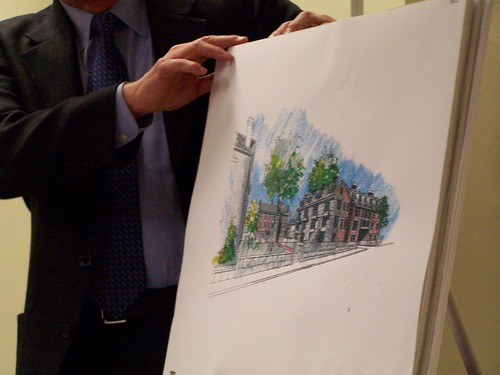
It's been a month since the most recent public meeting was held on the courthouse project. I haven't really wanted to comment on it. I was at the meeting recording it for SATV and I have never felt more alienated in my city than when I was there. Nevertheless, my thoughts and photos follow. This will be a long post.

This is the proposed design for the Courthouse complex at 30% design completion:
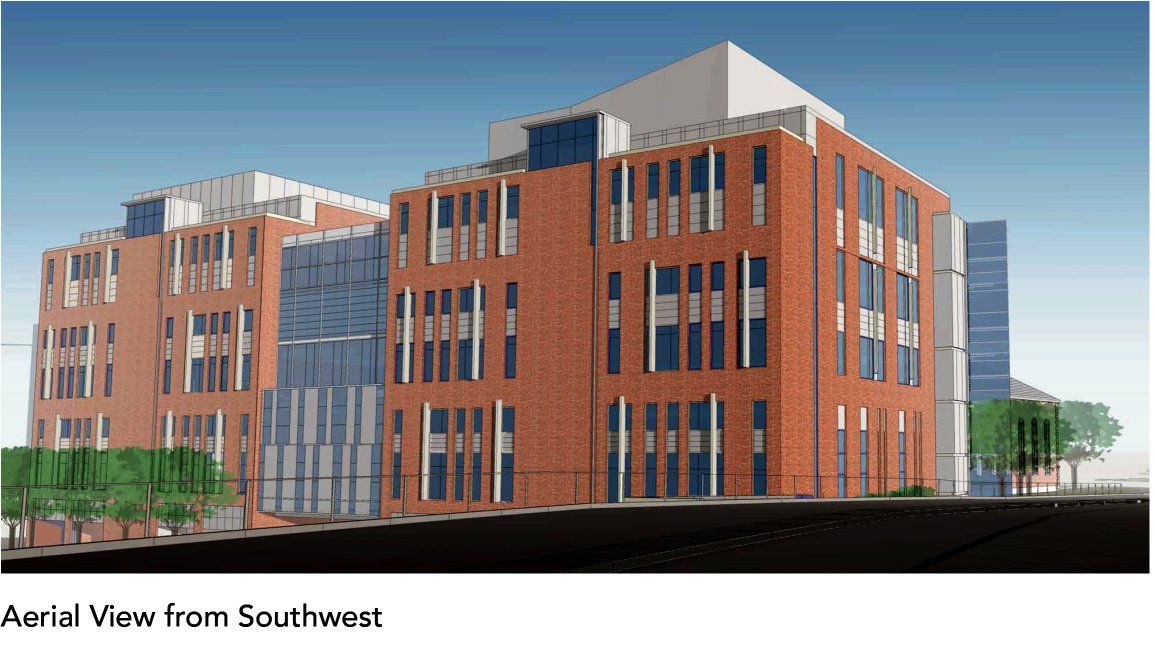
Proposed Salem court complex 30% design complete

[Source: Goody Clancy 30% Courthouse Site Plan and Renderings [PDF] at salem.com Studies and Reports.]

"It's ugly! It's too big! It doesn't fit the "character" of the City! It doesn't look 'historic'!"

If it were a knockoff of a McIntyre design, I'm not sure it'd be much better. When I see that courthouse I see my building in it:

This is where I live. Notice the similarities in the window treatments.

Or consider this familiar view outside my parking lot:

This is a view of the Essex County office complex at the back of the courthouse, taken a few years ago at winter sunset when the rotary still existed on Washington St.

This building was constructed in the mid '70s, at the height of the Brutalist architecture fad. It's an ugly building in the same way that Boston's City Hall is ugly. Yet, it is a familiar sight from my building and I never get tired of seeing it. It's become one of my favorite subjects to photograph, with all the lines and rectangular shapes that draw my eyes in, looming large in the frame as I shoot with a telephoto on Ash St, a half-block away.

(I enjoy photographing this "neighborhood" much more than I do the yuppie, twee, neighborhoods of Salem Common and Federal St! Another photo, and yet another!)

I can't get outraged about the design, even if it were presented as the final design rather than one that is but one-third complete.

The loudest voices in the courthouse shouting match were from those who wanted "history", whatever it is. The courthouse, according to them, should have been smaller. It should be "historic".

I believe they wanted the idea of a historic courthouse, the one you see in so many illustrations, and in films like "To Catch a Mockingbird". A cute little courthouse for a cute little sentimental historic town.

Except that Salem has never been such a place.

Salem has had a concentration of courthouse functions for as long as it's been a county seat. In a sense, the proposed complex just continues the historic pattern that has been a part of Salem's downtown for a very long time.

"The state just came in and railroaded the project!"

Um, no, they didn't. The courthouse complex has been discussed for a very long time. It may have even gone back to the construction of the District Court building (another Brutalist building) in the mid seventies, on the site of the former restaurant Grub and Grog's on Washington St. A courthouse complex, as the representative from DCAM told us at last summer's meeting, was in consideration for the Salem Depot site around 2000. The courthouse would be built on top of the Salem Depot parking garage. After 9/11 this was not seen as a good idea. (The experience of UMass Boston provides other good reasons not to do this.) There was even talk of relocating the courthouse complex to the old Danvers State Hospital site (now a residential development.)

As Patricia Zaido pointed out, this project has been in the works since its funding was approved in 2005.

The state is operating under some serious restrictions to get this courthouse in Salem. First, the existing buildings on the lot (except for District Court across the street) have to be preserved afterwards, and the complex must function while construction is going on. (The Registry of Deeds has already been temporarily relocated to Shetland Park.) And second, they must stay within the $106 million budget that has already been approved. Any delays would imperil this.

The state, as well, has some constraints to the design of a courthouse that they must follow. Any design must be functional and secure for several groups of people that use it: The judges and officials, defendants, witnesses, and jurors. All these groups must be safely managed and segregated until they have their time in court. The state has been very clear on this point. (It is to the discredit of the media that these details have never been mentioned, leaving people to imply it's a big courthouse just because the state wants it that way.)

In particular, juror services and amenities at the Salem complex are currently non-existent. Presently, if you want to erase court cases from the docket, for whatever nefarious reason, just let off the brake pedal as you move through Washington St. and run down the jurors herded across the street from the church that serves as a juror waiting room!

Now we come to the other controversy: The state will remove the east downramp to Bridge St. to accommodate the footprint of the court complex. The shouting against this was the most bitter I've ever heard in a public meeting anywhere. After the architect discusses the loading dock and sally ports needed to safely deliver defendants to the building, one guy goes "You don't need 40-foot trucks to deliver prisoners!"

I suppose if everyone on Federal St. conducts a sit in at the construction site, we might need those trucks! More to my point, there are 40-foot trucks outside anywhere you may live or work:

[Credit: iirraa on Flickr. Used under Creative Commons License.]

The courthouse has 11 courtrooms and it is a good sized office complex in its own right. Perhaps delivery trucks like these should be prohibited on Federal St? I'll support that!

The state cited traffic sensor data (PowerPoint) as evidence that the ramp was underutilized. Here's a picture of the ramp from last summer:

This was taken around weekday noon in summer I could have walked all the way down. I couldn't resist being a wise-ass when I suggested (during an unrelated meeting, when the topic came up) that this be Rowling's next book: "Harry Potter and the Magical Slip Ramp", as this ramp is purported to have the power to solve Salem's traffic forever. (Like the Bypass Road!) I though fewer ramps were good for the environment, or for urban character, or something to that effect.

I cannot think the state (specifically, DCAM, which is in charge of facilities) would take on the extra hassle of coordinating with MassHighway (working on the roadway) just because it felt like it.

What do I think of the courthouse?

I have some sympathy for those people worrying about traffic. Changes in traffic patterns are very hard to take and we have had outside consultants with failed plans come in before. Not to mention our home-grown Riley Plaza, Salem's quintessential failed urban renewal project.

I have a little sympathy for the architects who are concerned about the plans at 30%. One can hope the next spin of the plans will make it look better. Still, I could not muster much outrage if this were to appear outside Ash St. tomorrow.

I have no sympathy whatsoever for Polly Wilbert and the Federal Street crowd. They only want something that doesn't disrupt their property values. They would gladly sacrifice functionality towards a distorted sense of "history".

Right now, the state has every reason not to build the courthouse in Salem. The county government that concentrated our court system where it is no longer exists. Essex County disappeared as a government entity in the early '90's, except for the Sheriff's Department.

Were I head of DCAM, I would be looking towards Lynn or Beverly or Peabody, or even Danvers once again. Who needs a bunch of snobs?

I'd gladly let the courthouse go as well.

Except that if it goes, we probably won't get a new train station.

And we're in a recession that I think will get much worse, perhaps 1929-era worse. Worse than anything in my living memory.

That courthouse could loom large in more ways than one.

Postscript: Road reconfiguration has already started.

More thoughts on the courthouse.

Thursday, April 3, 2008

Gentrification in Salem

I don't often comment on pundit-bloggers like Instapundit or Daily Kos, but Megan McArdle hit a nerve with me:

One of the reasons that I left New York (I mean, aside from my awesome new job), is that I didn't like what the place had become. I grew up on the Upper West Side when it was still the place where Leonard Bernstein had set West Side Story: a poor-to-middle-class place with no good restaurants but all sorts of interesting local places. The fifteen-story co-op in which I was raised felt in a lot of ways like a very small town.

By the time I left, in my thirties, the Upper West Side south of 96th street was wall-to-wall investment bankers, and the ubergentrification was creeping towards me; I lived across the street from the last grocery store south of 125th street that didn't carry artisanal cheese. I have no objection to artisanal cheese, of course, but the monoculture was oppressive. None of the finance people or their associated service personnel seemed to live in my neighborhood; they came there to sleep. On weekends, they left for their country houses as quickly as their expensively garaged cars could carry them.

The road to Salem's gentrification began sometime in the late 1970's, when the Essex Street Mall was created, which blocked off Essex St. to traffic between Liberty St. (now New Liberty St. and the Museum Place Garage) and Washington St. The East India Square Mall (now Museum Place) was built, and there was the Pickering Wharf development (now a hotel). The first condo complexes were built on Central St., and Federal St. (at the corner of Washington across from the court complex).

At that time, the last remnants of the old Salem that I grew up with were fading away. The Paramount theatre that so many old-timers remember was gone by 1970. But in 1982, the biggest department store in Salem was no more.

Almy's, Bigelow & Washburn was gone. Due to congestion downtown and a declining economy, it closed forever. A condo complex--and the old Almy's clock--now sit on the site.

For me, that marked the end of the Salem I grew up in and the Salem I loved.

I had many happy memories of "going downtown" with my mom and her daughter to go shopping.

That was the start of my bitterness over Salem's change.

Salem experienced more decline. The Second Salem Fire happened around this time: The Salem Armory and the Masonic Temple were burned by an arsonist in 1981. (The armory's drill shed is now the visitor's center; the front shell, demolished, is now a park.)

Gentrification continued, with more steam, in 1985 when the Salem Common Neighborhood Association was established. My family lived in the public housing at the Phillips School in the neighborhood, so this was my first encounter with gentrification. Residents in my building were never really welcomed to SCNA's meetings. They still aren't.

Sometime in the late eighties and early nineties, yuppies began to discover Salem. They, and the city, also discovered Salem's history, specifically colonial history to 1812, to be good for property values.

Or, as I like to put it, the appearance of history is good for property values. Just ask Nathaniel Hawthorne.

Now, the forces of gentrification are just across my street. The Salem Jail is being developed.

And I'm unhappy, as you already know if you're a regular reader of mine.

McArdle references an article in the Times about the galloping class divide in Manhattan in explaining why she moved out. A money quote:

Robert H. Frank, an economics professor at Cornell, has written about the phenomenon of Americans who feel impoverished because of the towering wealth of those above them. In New York City, he said, those feelings are compounded by the sense that much of the wealth at the top is derived from financial instruments that merely move money around.

It’s one thing if people are adding value to society,” Professor Frank said. “But there is skepticism that this is all a shell game and these guys are not adding value, at least to the extent that justifies their salaries.”

What do people like Polly Wilbert do? I grew up around factory workers, my best friend Leo Jodoin is a carpenter, my mom raised foster children. What do the denizens of Washington Square or Federal Street do?

At least I can explain my own field of IT. I have never seen an explanation of gentrification in Salem that didn't involve historic-property owners capitalizing on their property values and refinancing, apparently to fund lawsuits against the city for destroying the "character" of their neighborhood, or against their own neighbors for repainting their houses in the "wrong" colors.

In New York, no one knows where gentrification will stop. I don't, either, but I know I won't like the journey.

Salem Jail update

[Rendition of the Salem Jail looking east down St. Peter St., from the SRA meeting in February]

The Salem Jail project that I've written about before has gone before the Planning Board. New Boston Development officials went before the board tonight to present their updated plan.


No surprises for the most part; they reiterated what had gone before at the SRA meeting in February.


It's been mentioned before that some units will be marketed as apartments to take advantage of federal funding. These will be in the "old" part of the Jail. There will be a "new" part of the jail in the existing parking lot at St. Peter, part of a new "parking structure". (Not mentioned, but I presume the old barn will be taken down.)


One member of the board asked about affordable housing. There will be one affordable unit.


That's one more than I thought would be there!

I'm not surprised. The SRA doesn't need low-income folks downtown. The Jefferson was supposed to be for "up-and-coming, affluent and hip" people too.

There'll be one parking space per unit per downtown zoning, which has been extended to the Jail. This means no families.

(I would like to see Federal St. zoned for no resident parking--horses only! But another post, please.)

There'll still be a restaurant. So they say. The rep from New Boston wasn't going to speculate further.

There is one last round of approvals from the city before construction starts. I didn't hear this part of the meeting very well, but I had thought I heard that this would come up at the regular SRA meeting on the 9th; not sure why it would come before the SRA again.

UPDATE: At the SRA meeting of April 9th, it was mentioned that the closing is scheduled for June. The project will be permitted in July and construction will start in August.

Sunday, March 30, 2008

Salem Jail Visit


Salem Jail Visit 009, originally uploaded by dmoisan.

I've been very busy with four different projects for people, but I was able to arrange for several of us from the Commission on Disabilities to get a tour of the Salem Jail . The city's Dan Stanwood, local expert, led us through part of the facility for an hour.

It was a fascinating tour. The building is foreboding, as befits its original purpose as a prison (and execution site), and I don't want to diminish the experiences of the prisoners there, but it looked like a handsome building, the state of the art for its time.

It's remarkable, if horrifying, that the building was still in use as late as 1991! Mr. Stanwood knew and spoke with quite a number of corrections officers who had been working at the facility up until it closed.

I had a video camera with me, since Mike Sosnowksi asked me to tape the tour. I have not looked at the footage yet but it will air on SATV sometime soon and I may put a segment of the tour up on the web.

I have mixed emotions: The Jail had outlived its usefulness and was dangerous for both inmates and officers alike in later years.

But as I've written before, I absolutely hate the idea of the Jail becoming condos. I hate that Salem has to live off its history, off of things that other people made and left behind so that arrogant yuppie property-owners can have "history" to check off on their property values.

When I applied to move in to the building across the street (as seen in the picture above), I was told by a Salem Housing Authority representative that when that building was open for elderly and disabled tenants in 1982, almost everyone wanted to be on "the other side" of the building (the one facing away from the Jail) and it was feared, jokingly, that the building would tip over!

The shoe is on the other foot and I am bitter. Now the Jail could be "desirable", "hip", "up and coming" and most important, "historic", er. "Historic". My building will now be "undesirable" and "low income". ("Why are you here, the old people don't have jobs to go to!" "Can't we just redevelop and move you to Lynn?")

I am SO looking forward to hearing that!

Resources:

My Flickr set on the Jail

Historic Salem's page on the Jail

Shaun O'Boyle's photos of the Jail

Thursday, February 14, 2008

Salem Jail developer switching from condos to apartments

Salem News reports that the Salem Jail, slated for development for over 15 years, will be developed as apartments rather than condos. On the Housing Bubble Blog, people refer to those as "repartments".

I'm not really surprised. The economy has been cited as the main reason for this, but I believe also that the changes that this area of Salem will undergo, notably the bypass road, will be more risky than many condo owners would want.

The developers, New Boston Ventures, briefly reviewed their plans at last night's meeting of the Salem Redevelopment Authority. There will be 36 residences and 22 of them will be leased as apartments for the first five years. There will be 7 permanent parking spaces for the complex in the Museum Place garage. There will be 5 spaces reserved in the garage for the senior housing complex next door (where this blogger lives), during construction. (Interestingly, it was not mentioned in the meeting, nor did I think to ask, if these spaces would be permanent. Parking is the most serious concern in my building.)

Here's a model:

The view of the model is from St. Peter St., with Bridge St. and the bypass road to the left of the frame and St John's Church to the right. The parking entrance is the "historic house" on the right, and the main jail building is left of the center courtyard.

A restaurant has long been proposed for the jail site, but no proposals were named at the meeting; Aquitaine had a proposal for the jail site several years ago, but had since pulled out. New discussions are ongoing but are said to be at a sensitive stage.

Rental prices were not given but the condos will be in the range of $400K to 700K.

My councilor, Mike Sosnowski, was very enthusiastic and could not stop praising this project.

I don't feel the same. I'm very upset.

Why can't the SRA promote something other than condos?

The Aquitaine proposal for the restaurant at the jail was killed by its grandiose nature: There was to be a new garage at Church St. (long a dream of the city but no money.) There was going to be valet parking to Museum Place. Those things were never to come together, indeed, they're not even on the horizon now.

So the SRA tries again to develop. And makes condos. What a surprise.

I'm angry with my councilor for approving this: Mike is a working-class lobsterman. There is no way someone like him or his family or kids could afford any of the apartments even if they were feasible for him. He could not afford Aquitaine had it been developed, and he will surely not be able to afford whatever restaurant comes in there.

If one comes in.

The approval of the Salem Jail project comes on the eve of what many believe is an oncoming recession. Many in the financial blogosphere even fear that we are back in 1929, headed for another, greater depression, brought on by the massive worldwide credit bubble that may have just popped.

Imagine 2010. The developers have half-completed the project. Still no restaurant, and it's rumored there'll never be one. Joe Yuppie, a new resident of the Jail, is trying to leave house for work. He'd take the train but because of budget cuts the trains are late and when he tried taking the train, it took 20 minutes to walk to Salem Depot in the teeth of the bypass road traffic. He missed his train and he was late. His boss told him "never again!" He'd like to get a job within walking distance but Dunkin Donuts doesn't pay enough.

So he's been idling at St. Peter St. behind a line of traffic waiting to get onto Bridge. It's raining hard. He sees his neighbor walking on the street behind him. He's not one of the lucky ones--he has to walk a block and a half to Museum Place to get his car. He can't wait to move out.

So too, does Joe. Joe has been sitting in traffic for ten minutes. He fumes, knowing that when he goes through the intersection, another one awaits at Washington St., and still others at North St. or Boston St. He looks at his watch, angry. He knows it will take him 20 minutes in any direction to get out of downtown, and 20 minutes after that to even think about reaching the highway, to 128, 93 and another workday.

Is this worth $700,000?

Other photos from the SRA meeting:

Friday, January 25, 2008

Nathaniel Hawthorne lives here?!


Two Hawthorne Boulevard 002, originally uploaded by dmoisan.

When I rail against over-entitled "historic" property owners and snob Salemites (Hi, Washington Square! Hi, Federal!), a bitter gibe I'll never stop making is that these people really think Nathaniel Hawthorne lives in their building or in their neighborhood, spreading historic character, not to mention property values.

At Two Hawthorne Boulevard, it's really true! This is a sheet of paper printed off a realtor's color laser and stuck to the corner of The Old Spot, kitty-corner from the hotel.

According to the website, units start at $200K for one bedroom. Nathaniel can be your neighbor at no extra charge. Granite countertops, too!