Friday, July 10, 2009

Outside Dining and Sidewalk Access

 Tavern in the Square

Tavern in the Square, the new restaurant that opened on the site of the old Salem News, wants to have outdoor dining at the corner of New Derby & Washington St. near the bus stop. 

This draws our interest at the Commission on Disabilities, since we are concerned about sidewalk access and what we call “path of travel”.

We’ll notice this come October.

I have no position on whether Tavern in the Square should be permitted outside seating, but I’ve been concerned about other outside seating.  Most notably, Rockafellas takes up a good chunk of Washington St., and I have had trouble getting by there in crowds.

Another serious bottleneck in the past has been Cilantro, which at one time had a seating area on Liberty St. (the “Haunted Alley”) which was virtually impassable anytime in October.  (The seating is no longer there.)

The Front Street Coffeehouse has a small seating area;  unfortunately, Front St. has a small sidewalk.

Tavern in the Square was already mentioned at one of our meetings.  Jack Harris heard from one person who claimed their entrance was poorly lit and marked for the visually impaired.  I’ll probably have lunch there sometime to see, or not see, for myself.

No doubt we’ll be bringing this up at the next meeting.

More on Salem’s Transparency

Salem City Hall plaque

Last night, as I mentioned before, there was a meeting of the City Council’s Subcommittee on Ordinances, Licenses and Legal Affairs, on their proposed changes to Salem’s Sunshine Ordinance.

I was at the meeting, but instead of the long speech in defense of transparency I’d expected to make, I was reminded of just how hard it is to expose the city’s proceedings to the public, both for the logistics and for the constant balancing that has to be done between all the interests involved. 

During the meeting, the subject of SATV came up, and I was asked what SATV was doing to make public meetings available on line (not just over the air.)

The unfortunate answer:  We aren’t doing it right now.  We haven’t been able to get the money and the resources together.

Few realize just how expensive it is to provide storage and bandwidth for meetings.  The questions come in a flood:  How many meetings?  How many years of meetings?  Which meetings?  Low-res or high-res?  Bitrate?  How many people would watch?  How do we get a transcript?  Do we store audio, too? 

The IT staff of SATV is one person.  The IT staff of the city (Joanne Rust’s) department is four, or was when I worked there over 25 years ago.

OK, that means we buy a service.  Last year, Mrs. Rust herself came to SATV with a idea of using the city’s web provider, Virtual Town Hall, LLC.  I liked the idea but it didn’t go anywhere at the time.  Budget concerns.

Resources.

I’ve recorded meetings of the Salem Commission on Disabilities for 10 years.  That much I’ve said, on numerous occasions.  But I’ve not told the blog exactly how I do it.  This is how a meeting goes for me, in addition to the normal business I have as a commission member.

I take out the camera, a personal hard drive, audio mixer, microphone, and our Firestore, a device that records to a hard drive from a camera, and setup at SATV’s conference room, where we meet.  Fortunately, it’s only down the hall.

I run over to Dunk’s to get a coffee, start the Firestore recording and we begin a meeting which is usually 90 minutes long, most months.  (If we have a guest, it can be 2 hours.)

Then I pack up.  I take the Firestore and my hard drive over to one of our Macs and prepare the meeting for air.  The video is edited only to add titles and a graphic and to remove extraneous video I might have before and after the meeting itself.  (Andy LaPointe wanted us to have theme music for our meetings.  And we do.)

During the production process, there are numerous waits for the video to be encoded or graphics to be completed, so it can take some time.  After waiting, the video is burned to a DVD and also transferred to SATV’s video server through our internal network.  At the same time, I make an MP3 copy of the meeting audio.

That process takes me at least two hours and sometimes three.

When I get home, I’m not done.  I volunteered to do the minutes.  I don’t have fun doing it, due to my hearing impairment, but I volunteered or it wouldn’t get done.  I use DVD playing software on my PC and transcribe it to my blog, posting an unofficial copy.  A copy is saved to Word and forwarded to Andy LaPointe, who reviews it and sends it to Tom Watkins, who posts it on salem.com.

That can be a three or four hour process, which I never do the night of the meeting;  it’s too much, especially if I want to do it right.  I try to get the minutes out 5-7 days after the meeting.

The DVD’s are stored at my house and the audio files are stored on a server I maintain at home. 

Yes, you heard me right.

The physical DVD’s should be stored at City Hall or wherever is deemed safe (Joanne Rust would know).  But I’ve been doing this as a personal project for the 10 years and have had minimal city support other than what the Commission gives me.

Fortunately, the costs of recording video have dramatically dropped so that it costs me very little.

I’ve avoided asking for budget items out of the Commission’s budget because it is very small and what we do get often needs to be put to use for more important uses (such as Andy needing a piece of Braille equipment to conduct his business as a member.)

This is the story of the city’s transparency effort writ small.  The City Clerk’s office runs behind on minutes (18 months behind on some meetings) because they are short of staff.  We should not be surprised that the subcommittee wanted to lengthen the deadline for submitting minutes.

“Work more with Less”, people say.  “Union hacks!” say others.  But if you haven’t got the people or the money—remember, government is bad, starve it!—little wonder that the city can’t meet the terms of the ordinance it now has.

From the tone of last night, I thought the city was trying to keep up with the Internet (I’m surprised no one’s asked the mayor to be on Twitter!) but falling behind for lack of people and money. 

Web 2.0 does not write itself and this great transparent world promised to us will not happen.  It may take time, people and that scary prospect, money, to fulfill itself. 

MBTA Cuts and Fare Hikes

455W at North St

As many of us expected, the MBTA has proposed a 20% fare hike in return for not cutting service.  Otherwise, the MBTA will drastically reduce service to Salem and elsewhere.  I’ve been dreading this possibility for some time. 

From the MBTA’s booklet, and No Free Transfer, the details for Salem.

Bus Service:  These routes would be eliminated:

  • 451 Salem-North Beverly
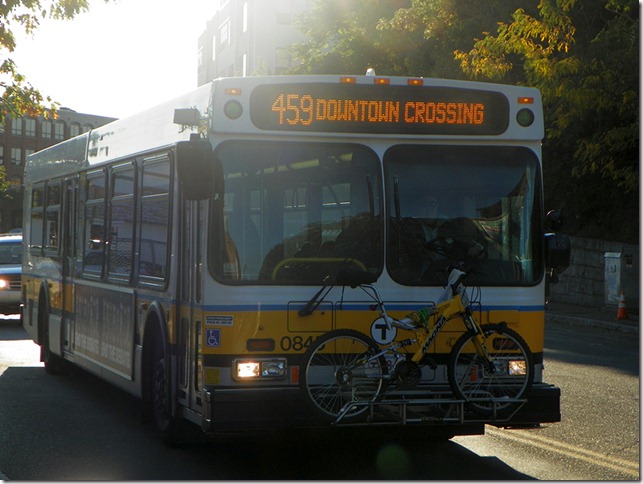
  • 459 Salem-Downtown Crossing
  • 465 Salem-Liberty Tree Mall (and all routes in and out of Peabody)

These routes would be changed:

  • 450 Salem-Haymarket via Western Ave.
  • 455 Salem-Haymarket via Loring Ave.

No details were given.  (My guess:  Service cut back to Wonderland, as on the weekends, but with increased waits for a bus.)

Bus service would be reduced after 8:00 on weekends.  Service from Lynn garage (where Salem routes originate) would be discontinued on weekends, implying no service.

Private bus service subsidies would be eliminated:

  • Beverly
  • Peabody (shuttle service to Centennial Park from Salem)

Commuter Rail:

  • No service after 7:00 PM weekdays
  • No service at all on weekends

Commuter Boat service will be eliminated.  No details how this would affect the Salem Ferry’s new commuter pass program.

The RIDE:

  • Beverly and Peabody would no longer have RIDE service.

It should be an understatement to say this would be very bad for Salem.  If we accept the cuts, where would it stop?  The Driscoll administration (and I) wants a new Salem Depot.  If we lose most of our service, where would the justification come from for this (so far) $30 million project?

I’m particularly upset (though not surprised) over the prospect of losing the 465.  It has been a bus route for decades, having been run by the Eastern Mass. Street Railway, Michaud Bus, ABC bus and the MBTA.  It’s how seniors without cars get to the senior center in Peabody, and how they would get to Salem’s proposed senior center.

Several of my physicians are in the medical offices behind the Northshore Mall.  I and others would have no way to get to them without a car!  I can hear people say, “well, you shouldn’t be out shopping anyway!” since the route has served both shopping malls in Peabody, but doctor appointments, well…

In the past, the T has never cancelled a fare hike.  It came several years ago when the T introduced its CharlieCard, and I’m not expecting anything different.

All of the outrage over fares is too familiar.  As is my cynicism over people who tell T riders to pay their own way while they clamor for road projects on the state’s dime.  Gas tax?  Nope.

It’s not true, as some think, that “the poor” or those on “fixed incomes” get a break on fares.  Some people with disabilities can get a discount, as can seniors.  But virtually everyone else who cannot afford a car pays the full rate.

Public hearings and “workshops” are set.  One is in Salem:

Monday, August 17
City Hall Annex, Room 313
120 Washington Street, 3rd floor
6:00-8:00 PM

The main public hearing is in Boston:

Thursday, August 27
Boston
State Transportation Building
10 Park Plaza
5:30-7:30 PM

Specific details on the fare hikes. 

UPDATE:  Disabled riders are already affected.

Wednesday, July 8, 2009

Fighting for Transparency in Salem: Revising the “Sunshine Ordinance”

City Hall Desks

Tomorrow night, July 9th, there will be a special meeting of the Salem City Council Sunshine Ordinance subcommittee to discuss proposed changes to Salem’s “sunshine ordinance” laws.

Quoting Maggie Lemelin Towne, Administrative Coordinator, Alliance of Salem Neighborhood Associations in today’s News:

The Sunshine Ordinance, as approved by the City Council in September 2005, requires the city to post meeting schedules, meeting agendas, legal notices, bids, RFPs, RFQs and all city reports and filings made by the city. Additionally, it provides a facility for citizens to sign up to receive automatic e-mail notifications of scheduled meetings, with agendas, for all governing bodies, and requires the posting of meeting minutes within nine days of the meeting. These components have provided the City of Salem with transparency in government, a modern sensibility to our open meeting laws and easy access for all citizens to be engaged and involved in the governmental process.

Recently, significant changes have been proposed to the ordinance, including removing the e-mail subscription service for meeting agendas, changing the requirement for meeting minutes from 9 days to 47 days, and eliminating the requirement to post city contracts and required legal reports.

I have philosophical differences with Salem’s neighborhood associations, but I have to stand with them on this point.  I’ve been standing for transparency ever since I began filming meetings of the Commission on Disabilities nearly 10 years ago.  This is what I told my colleagues in email last week and this is what I hope to say at the Council tomorrow night:

Next Thursday there is an important meeting of the Council that I would like you to attend.

You may have seen a letter in the Salem News last week “Let Sun Shine on Salem City Hall” [an earlier letter on the same topic] and you may have seen my comment to that letter online.

Ever since I began videotaping Commission meetings 10 years ago, I’ve come to believe very much in openness.  Except for those times we have to maintain someone’s privacy, we have done our business in full view of the people of Salem.  This openness has made us one of the most effective Commissions on Disabilities in the state.

It wasn’t always like that. 

I believe we are far ahead of the rest of city government.  I want us to set the example for openness, but I also want to do all I can to encourage the other boards and commissions in the City to open up their business as much as they can.

It’s not easy to ask for.  Indeed, I’ve had trouble taping meetings for my personal blog just a few months ago.  Not everyone in government sees the importance of this.  Even our state senator doesn’t understand it.  We love Senator Berry very much and consider him a proud member of our disability community, but if you’ve been following the news about our state’s new ethic laws, he closed meetings to the public not because they were sensitive or under executive session, but just because of “tradition”.

There seems to be too much of that “tradition” going along.  I remember years ago when SATV first got cameras in City Hall and Lynn refused to put cameras in their city hall because “there was no air conditioning there!”  It didn’t take a cynic to read between the lines and realize the cameras were not in Lynn also “for tradition’s sake.”

But for every time a public meeting is not covered, people complain about conspiracies;  sometimes SATV has technical problems and people accuse them of colluding with Mayor Driscoll or other officials to hide the tapes;  there is no such thing; we have no secret tapes.  The only way people can really trust government is to be as open as we can possibly be.

This has downsides;  sometimes we in our great familiarity in our meetings, forget that.  Other times we need to be very respectful of our citizens’ privacy and the understanding that not everyone with a disability can “come out”.  Chairpersons everywhere in the city have to balance what they put out in public and what is done privately in the course of their business.  They must balance transparency regulations against their ability to meet them.  I won’t say it’s easy and we have struggled with these issues in our own commission. 

We live in a time when it’s fashionable and even required to deeply resent and hate our government.  We hear from many who would want government to do nothing and just go away.   People don’t trust our government: Salem, Massachusetts, or the US, and there is not a thing we can do about it just by saying up and down that “we’re honest, we don’t lie and we don’t cheat, trust us!”

We have to show our hand.  People need to see the routine, mundane and even boring things we do to run the City.  They need to see what we see.  And if they see something they don’t like, I want them to be able to call us out, not to resort to talk radio or the comments section of the local newspaper. 

But they can only see that when they can see us.  Openness and transparency are the only ways we can get back our legitimacy and get the trust of the citizens of Salem, just as they put trust in our Commission.

Wednesday, June 24, 2009

“Walls Do Not a Prison Make…”

“..nor iron bars a cage.”

The bars on the window of the Jail are being removed this week.

For the first time, you can look into the building!

Looking forward to seeing the fence come down, one hopes soon.

Monday, June 22, 2009

Salem Commission On Disabilities June 2009 Unofficial Minutes

Morency Manor Parking sign

The June meeting of the Salem Commission on Disabilities took place June 16th, 2009 and started on time at 4 PM.  Present:  Jack Harris, Chairman, Commissioners David Martel, Michael Taylor, David Moisan, Andrew J. LaPointe, Charlie Reardon and David Tracht.

Old Business:  Project Lifesaver update. 

Andy led off the meeting by discussing Project Lifesaver, which was recently featured on Salem Now the week before [discussed last month—DM].  Andy gave a brief update:  Capt. John Jodoin, and two officers from the Norfolk Sheriff’s Dept. were on Leo’s show to introduce the program to the viewers of Salem.

Andy:  We’re looking for donations from groups and businesses to sponsor this.  It started in 2008, needing $10,000, but now the equipment is free to the police dept. with only the cost of the bracelets to be paid for;  once $300, now costing $99 plus $30 a month.  It’s Lojack for people.  When someone goes missing, the police go out with their equipment and can find the person in 30 minutes.

We’re one step closer to getting it in Salem.  I have no idea why we don’t already have it.  I understand the city’s trust fund has some money for it, but with the economy, I’m not sure what’s happening.

The Friends of the Council on Aging have $500 from Dominion Energy which we are setting aside for that program, leaving us with $2500 to raise.

Jack:  I think it’s perfect for kids.  You don’t have to go far to read stories about kids missing, whether disabled or not.  And a lot of overprotective parents, which makes it more tense.  If you have a safety net in place to keep these kids from being lost or abducted.

Dave Martel:  There was a case like that in the news recently.

Jack:  That’s why we have safety nets like that;  it’s too bad we have to have them.  My generation had kids in a neighborhood when the neighborhood was looking out for them, but people are transient these days, and the neighbors can be dangerous themselves.

Mike:  It’s for the elderly, too.

Andy:  No criteria for age.  Just disability.  There are more people than we know who have family members at home with Alzheimers or dementia or another disabilities whom they have to look after.  They have to go out.  They can’t stay at home at all times;  they need to be out to shop and run errands and look after themselves.

Mike:  My father had Alzheimer’s and was in a nursing home in Florida.  He had a bracelet.  They found him on a highway.  Very scary.

Andy:  The program is for these people in mind.  I spoke with the lieutenant from North Andover, and they were one of the first communities on the North Shore to have the system.  He contacted me, and he’s trying to get Project Lifesaver regionalized.

If someone goes missing and you don’t know about it for three hours, you don’t know when they left--they could be anywhere!  When you report someone missing, Danvers, for example, will put out a APB and cruisers will look for the signal.

Andy:  The bracelet puts out a unique signal [a code similar to LoJack]  Being a ham radio operator, like Dave (Moisan), we do a thing called foxhunting where we look for hidden transmitters on 2-meter simplex [a mode of radio communications.]  We just sit there and wait and find the signal.  We did this at the Marblehead lighthouse once.  It’s really an amazing thing.  I think the guy who came up with LoJack must be a ham radio operator.

Jack:  How often will the program air?

Dave:  At least twice a week from now til July.

David Tracht:  Is there a phone number viewers can call? 

Andy:  You can contact me (Andy, 978-745-4289) or the Friends of the Council on Aging.   Checks should be made to the Friends of the Council on Aging and addressed to 5 Broad St.

After the program goes into effect, we’re going to start a fund for people unable to afford the costs.  I’ll talk with North Andover again.

David Martel:  Insurance won’t cover it?

Andy:  Insurance may.  Depends on the program.  As you know there are many people with insurance you would think would qualify them, but that it isn’t the case.

Mike Taylor:  It really depends.  If a physician could be involved or not.  Andy, some of the emergency call services waive the registration fee, I’m wondering if Project Lifesaver could do the same.  It could entice people to sign up even if they couldn’t put up the $100 up front.

Andy:  Project Lifesaver initially had a cost for the bracelets, but no monthly fee, but the costs went up.  You can find out more from their website at http://www.projectlifesaver.org/ 

David Martel:  Can the police help us with grant money?

Andy:  I called John Keenan and emailed him all sorts of links from the website.  I haven’t heard from him so far (in three weeks).  I called his assistant Jody at the state house, that was the day before the show. 

David Martel:  You know George McCabe?  He works in Tierney’s office.

Andy:  The reason why we had the show was merely because the media was the best way to get my message out.  Someone’s out there saying, “2500 bucks is cheap to pay for peace of mind!”, I hope.

Back in January, Charlie, and Dave Goggin, came with me to North Andover, and everyone was excited about it.

Andy:  My mother is not one to wander.

Jack:  You never know.

Andy:  I’m disappointed in the Rotary Club.  I wanted to do a presentation for them in Peabody, where we do the training for handicapped parking violations training.  We were going to videotape it.  That didn’t work.

Someone out here will see this, and I hope…

Charlie:  This actually happened in Salem a year ago.  It had a happy ending

David Martel:  A man on Hanson St., a retired college professor, wandered off and was found in the basement of an Essex St.  apartment.

Andy:  If we’d had the system, we would have found him sooner.  Someone with a tracking antenna would have found the signal and gotten out of their car and found him.

Jack:  The Commission can be proud of bringing this to the city’s attention.  We first heard about it at a conference three years ago.  I tell people, as I tell the Commission, things don’t happen overnight.  This program  as close as we can get to being established and the most important

Old Business:  Forest River Conservation Area

Jack:  Old business.  A resident of south Salem who used to be on the Conservation Commission asked us to look at the Forest River conservation area behind South Campus.  The commission asked us to do some evaluations there a few years ago.  The way we left it was that we needed to get the Army Corps of Engineers involved, but then the [Iraq] war broke out.  We had also wanted to get into the Salem Woods and make some trails accessible to people with disabilities.

That individual was very proactive in getting us out to Forest River in the first place.  I’m not sure what his concerns are now.   I’m going to ask the Conservation Commission for additional information, but they probably don’t have info, time or money to do anything.

We can’t and don’t want to put concrete sidewalks on conservation land, but we should see what we can do to make the trails more accessible to people with disabilities

Charlie:  Scott Maguire [former commissioner] was out on his wheelchair on the South River, and we found he could go on gravel, which is a natural surface for its surroundings.

Jack:  We may need to look at that as Salem looks at its recreational areas to see how accessible or inaccessible they are.  We will have ongoing discussions with the Conservation Commission and the Conservation officer.

David Martel:   I heard from someone at the Hawthorne Commons condos next to Hillcrest Chevrolet.  There are no curb cuts between the entrance of the building and the driveway.  He has to go out to the driveway and go back in to get to the parking lot.

Jack:  Call Tom McGrath or Tom St. Pierre and let them know.

David Martel:  He’s asked me and wondered the correct avenue to resolve this;  I asked him to be here today.

Andy:  I was involved in a condo issue near Traders Way and we had a meeting with some people from the condo association.  We pointed out the situation and got the problem resolved.

Andy:  Getting back to the trails near South Campus, if I’m not mistaken, there’s crushed stone, which doesn’t work too well for wheelchairs.

Jack:  That may be, but no one is coming to us telling me what we should use.

David Martel:  We put peastone, in the case I was involved with;  the area was very rustic.  Charlie:  peastone is loose, but gravel is packed down tightly.

Jack:  That’s an issue we’ll continue to keep an eye on but I wanted people to know of this. 

David Martel:  It’s a rustic woodsy trail with not much use.  Perhaps if it were accessible, there’d be more use.

Old Business:  MAAB Update, “Sober House”

Jack:  As some of you remember, on Salem St. in the Point, a  gentleman was trying to build a “sober house” because he felt the need for it.   Problem was, it was supposed to be made accessible by code but was not, so the city took him to court.  The MAAB wrote a letter to the court explaining why it needed to be accessible.  The court ruled in favor of the city.

In the meantime, the owner was arrested for fraud amongst other things, serving at least six months for probation violation with other charges pending.

I got in the mail a request for a variance for that building.  His name was on it, but another person was listed.  I understand the owner could not be involved in the project.  The variance is for vertical accessibility and bathroom accessibility.  I’m in touch with Tom Hopkins at the AAB and Tom McGrath and Tom St. Pierre at the city.  

David Martel:  We only know what we see in the papers.  They were cited for lack of sprinkers too.

Jack:  I want a meeting [with Tom, Tom and Tom].  That’s not to say the variance may not be reasonable but with the background of this property we need to see this as clearly as we can.  I’ll let people know when this meeting happens.  Tom McGrath has sent a letter to the AAB with his concerns and the AAB has seen the variance request and we want them to wait until we have our meeting.

Old Business:  MAAB, Witch House

Jack:  The other MAAB matter, as people are aware, there was a variance request for the Witch House which was accepted in full so the project will continue forward.

Old Business:  MAAB, Bypass Road Bike Path

Jack:  One last bit of MAAB business is the bike path on the bypass road.  I got some confusing updates on that, but it is being attended to and hasn’t been forgotten.  I remind the city not to sign anything until it has been resolved since it may cost money (in fines) and looks like it may.  An ongoing issue as we speak.

Old Business:  Ginny Morse, Disabilities Policy Consortium

Andy:  Ginny Morse sent me a DVD that the Mass. Office on Disabilities did with her office on sensitivity training, at their office on Ashburton Place.  I want to make copies for the Commission. Dave Moisan, can you make copies.  Dave Moisan:   You have permission from them?  Andy:  Yes.  The reason I requested a copy was, we do sensitivity training but I want to see what they do.  It could be a perfect complement.  How many copies?

Jack:  9 members, plus Jean L. plus Mike Sosnowski.

Andy:  And also for Mike Taylor.

Jack:  To add on to that, that particular meeting was for emergency preparedness.  There was a piece in the Globe about the fact that the federal government is not on top of having supplies to deal with the flu epidemic right now.  I thought, “here’s why it’s important we think about and look at Salem because we can’t save everyone else, but if Salem has a good emergency plan, we can get through.”  I hope the state and federal governments follow through, but if the reports are true, everyone needs to get on the stick and nobody is.

New Business:  “Tavern on the Square”

There’s a new restaurant in Salem at the corner of New Derby and Washington.  I’ve heard from several people that the steps into the new restaurant are hard to see and not delineated by visible striping for people with visual impairments.

The other thing you may have been following in the papers:  The Salem Mission has done two things;  they have closed their food pantry, merging it with St. Joseph’s [situated at the Immaculate Conception on Hawthorne Blvd.].  And, the Mission wants to establish a small medical clinic in the space where the food pantry was.  I’m not sure what the guidelines and regulations are, but we would like to get up to speed.  They also, depending on another issue, want to convert the church itself to housing.  If that happens, that will tip the 30% and they will need to bring it up to accessibility.

[Note: Under current regulations, if a building is renovated and the costs of the renovation are 30% of the value of the property or more, the property must be made accessible by current codes and standards.—DM]

Jack:  Mike, with your background, you could help us figure out what’s going on.  The housing situation balances on what happens to the art group that’s using the building and wants to renovate the whole building into an arts building.  The 30% wasn’t a issue for the arts group because they didn’t make that many changes to the building when they used it.  If the project goes forward, they will trip the 30%.

The Commission has been involved with the Mission in the past;  when they established the homeless shelter, we were very involved with them on the renovation.  There’s a lift in there, and some other things that were done.  We have established ourselves, but as always in any community, we need to keep an eye out for them.

New Business:  North St. 

Charlie:  I was approached about a handicapped sign on North St.  Someone was ticketed at a sign, but the sign was old and not valid.

Jack:  Supposedly, there’s supposed to be a review of all handicapped signs in the city once a year.  Invalid signs that are no longer needed are to be removed.

New Business:  GPS Demonstration

David Moisan:  Andy, I’d like it if you could demonstrate your new GPS unit for the Commission.  It would be good for us, but I would also put the footage on YouTube.  I had wanted us to do that but there haven’t been many opportunities—the last time I got to do that was with Charlie and Jack on the new voting machines last November.

Jack:  We have a guest coming in to discuss his agency that helps disabled people over 22 get health care and residential care when they can’t look after themselves.  It’s an area we don’t hear about publicly, but I hear about this very very often.  After 22 and under 60, it is very hard for people with disabilities.

Andy:  Milt [the person from the Conversation Commission] wanted to come this month but I suggested next month.  Jack:  I’ll talk to him and have him come in only if there’s something going on;  I won’t have him come in if we can’t do anything for him.

David Martel:  Entrance at Loring Ave.?  Andy:  It’s behind Harrison Rd. and South Campus.

Jack:  I want to do anything we can in that area but it takes time.  If we can’t do anything, it makes no sense to have him come.  David Martel:  It is a protected area and there are a lot of wetlands and lots of trails without rails.   Jack:  There are other groups that have worked on the area from time to time.  It’s a matter of money, time and resources.  If we can find out that out I can certainly get the information out to Andy and thus to Milt.  We do want to make it accessible as possible but we can only work with what we can work with.

David Martel:  What about the playground at the Common?

Jack:  No official word.  The city has promised them some money.  They’re a long way off on their target of $250,000.  But they’re still working on fundraising so far as we know.

The meeting adjourned around 5 PM.  Next meeting is July 21st, 4:00 PM, Salem Access Television.

Saturday, June 20, 2009

MBTA schedule changes for routes 450, 456 and 455

MBTA Bus Sign 2009-06-20  (5)

The MBTA has announced schedule changes for Salem bus routes effective Monday.  These changes were first put forth by the MBTA last winter and they affect route 450 and 456 significantly during the weekdays.

Route 456:  This route will now run every 80 minutes (1 hour and 20 minutes) instead of every 60 minutes.  Buses leave Salem at 9:40 AM, 11:00 AM, and every hour and 20 minutes until the last bus for Lynn at 4:20 PM.

From Central Square, the first 456 leaves West Lynn at 7:00 AM and 8:30 AM (rush-hour service), and starts its regular service at 9:00 AM, 10:20 AM and every 80 minutes until the last bus for Salem at 3:35 PM.

Route 450:  Weekday service outside rush hour (9 AM to 4 PM) runs to and from Haymarket at 60 to 80 minute intervals, leaving Salem at 9:10 AM, 10:20 AM, 11:40 AM, 1:00 PM, 2:20 PM and 3:40 PM.  Buses from Haymarket run at 9:10 AM, 10:20 AM, 12:00 Noon, 1:00 PM, 2:20 PM and 3:10 PM.

Route 455:  Quoting the T:

The 5:19 AM outbound trip leaving West Lynn for Salem Depot will now leave at 5:16 AM.
A new trip will leave Salem Depot for West Lynn on Route 455 at 7:00 PM.

No changes to weekend service on the 450 and 455 (456 is a weekday-only route.)

The biggest changes are to the 456, a route I take most often.  The T cites congestion on Western Ave. and 107.  It’s true that over the past 20 years, Rt. 107 between Salem and Lynn has gotten more and more congested—the recession hasn’t changed it a bit!  When the T cites “schedule adjustments”, they’re really saying they can’t keep to the schedule, or more importantly, they can’t afford to run extra buses to maintain it. 

The 456 in particular gets quite a lot of use by Lynn residents who shop on Highland Ave. and use North Shore Medical Center.

As I write this the T is contemplating a 20% fare hike and service cutbacks.  There’s been no news at all, despite the much heralded transportation bill before the Governor.

MBTA bus schedules are revised every quarter;  the next revision will be in September.  If the ax falls on MBTA service in Salem, it’ll happen in December, the next quarter after that.  I’ll be watching.